
By: Shaniqua Mayers
In collaboration with The Starfish Canada
“Systems change happens through multiple pathways, including policy and legislation that address the structural roots of issues like climate change and environmental racism.”
When you look outside your window, what are your eyes met with? For me it’s a lone tree at the back of my neighbours house, lush grass and my father’s vegetable garden. But many others aren’t met with that view. Instead, they look out on garbage piles, chemical facilities, highways, and factories. Environmental justice means asking: why do some communities get trees, while others get toxins?
To explore that question, I sat down with Dr. Ingrid Waldron, HOPE Chair in Peace and Health at McMaster University, and a leading voice on environmental racism in Canada. Her book There’s Something in the Water was adapted into a 2019 documentary, and she co-developed Bill C-226, Canada’s first environmental justice law. Her research and advocacy focus on environmental justice and health equity, shaping national conversations and influencing policy on systemic racism and climate impacts.
This article is written in collaboration with The Starfish Canada, a national non-profit organization who has encouraged young Canadians to celebrate their peers’ contributions to the environmental movement and to assume leadership positions in their communities, with a mission to amplify youth voices through strategic pillars such as “equity and justice”.
At Terra Elysium, we empower youth in Neighbourhood Improvement Areas (NIAs), with a focus on communities in Jane and Finch, Kingston-Galloway/Orton Park, Parkdale, and Weston. While we primarily serve these NIAs, our programming spans across Toronto and centres environmental education, eco-arts, youth justice, cultural diversity, and community advocacy.
We spoke with Dr. Ingrid Waldron about storytelling, health equity, and what gives her hope. At Terra Elysium, we are guided by the values of Educate, Explore, Express. We reimagine NIAs as vibrant hubs of innovation, potential, and environmental leadership—places too often overlooked, yet filled with rare potential and deep-rooted hope.

“Photo by Kat Rizza, City of Toronto Cultural Hotspot Launch Event 2025”
In June 2025, we launched Terra Pulse: The Greenheart Collective, a cultural community arts program and City of Toronto Cultural Hotspot SPARK Project in Jane and Finch.
This program has explored a variety of diverse art forms including collaborative visual arts like painting, drawing, eco-art collaging, as well as the creative repurposing of textile waste through tote bag making. Our upcoming workshops will focus on music creation and filmmaking as powerful tools to uplift the Jane and Finch community and shift dominant narratives. The program runs through to October 2025.

“Photo by Kat Rizza, City of Toronto Cultural Hotspot Launch Event 2025”
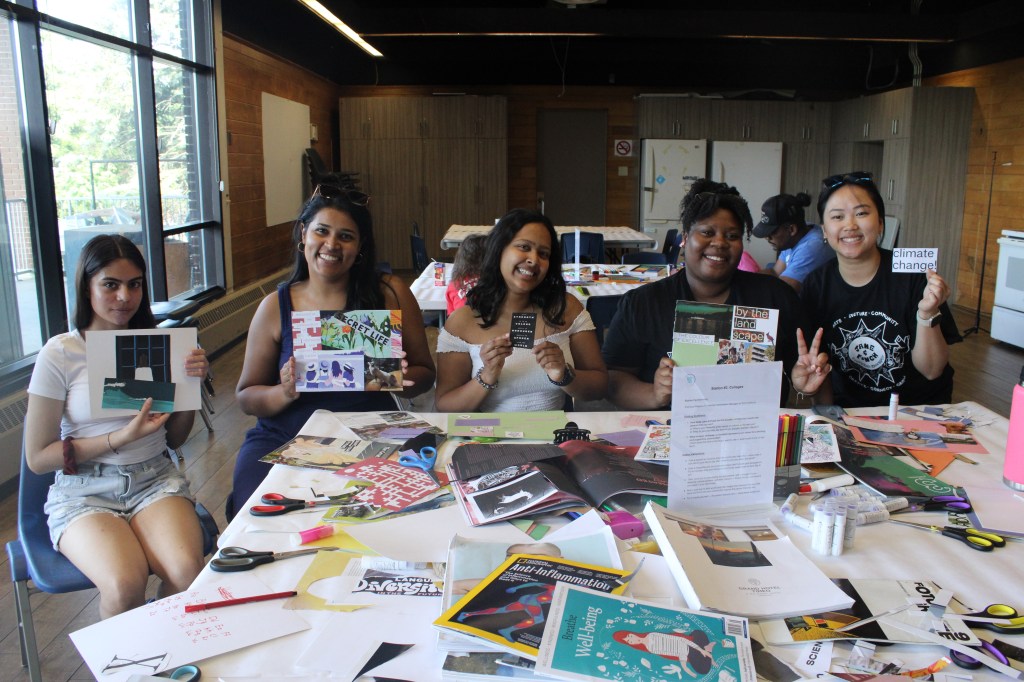
“Photo by Terra Elysium Foundation, Terra Pulse Workshop #1 (2025)”
All workshops are free, fully accessible, and include food, drinks, art supplies, and meaningful community connections. Everyone in the community is welcome to attend. Local youth (ages 14–25) are invited to apply to our youth mentee stream.
Our conversation with Dr. Waldron deepens our understanding of environmental racism and will help further our engagement with NIA communities—many of which have faced long-standing social and ecological injustice throughout history. We recognize that environmental racism is not only present in Toronto, but persists across Canada and around the world.
For real-time updates and details on how to attend a Terra Pulse workshop, visit our official program website page and follow us on social media.
My first question for you is, what role do you believe public education in media, such as your book and documentary, There’s Something in the Water, play in systems change?
“Education is critical, helping current and future leaders understand these systemic underpinnings through diverse formats like workshops, symposiums, or creative mediums. Not everyone learns best from books or journal articles, which is why I’ve turned to documentary filmmaking as another tool to raise awareness. Ultimately, what matters is that people are learning in ways that lead to informed decision-making because education and awareness are foundational to creating lasting systemic change. Many people are not interested in reading an academic book or journal article to learn about environmental racism, especially if they are not in the academic space”
From a health scientist perspective, what does environmental justice mean and look like to you?
“For me, environmental justice refers to the tools and resources that are created or that may exist to address and redress environmental racism. So environmental racism is defined as the
disproportionate siting or placement of toxic facilities and other environmental hazardous projects in Indigenous communities and communities of color, such as Black communities. That’s environmental racism, the fact that government and industry disproportionately place these toxic facilities in communities that are marginalized and that are racialized. So environmental justice refers to the tools that will be developed and the resources that can be developed or that exist that would help to address and redress that injustice.
An example of environmental justice is Bill C-226, which I co-developed with former Liberal MP Lenore Zann. That is now the first-ever environmental justice law we have in Canada, and that became law in June 2024. I consider that to be an environmental justice tool or resource to address environmental racism.When we discuss environmental Justice, we have to consider the tools that we need to be used to advance environmental justice due to the reality of environmental racism, right? There’s community advocacy, community activism such as civil disobedience, environmental justice policies perhaps within organizations and then we have, what I think perhaps is the most important: environmental justice legislation or environmental justice laws.”
My next question is a little bit more about challenges. What challenges have you faced when trying to bring visibility to environmental racism in Canada? And how have you navigated them? So were there any challenges when it came to passing Bill C-226 or were there any other challenges when it came to your documentary?
“I started the work on environmental racism in 2012 in Nova Scotia, and right from the beginning, there was doubt about what I was doing because of the term environmental racism, which to many people seemed like a very strange term. I had never heard of the term before and wondered, how can the environment be racist? Because people didn’t understand the term or its systemic underpinnings that environmental policies themselves can be racist, they doubted the work. I had to do a lot of reading to understand it myself, and many people thought it was more of a class issue than a race issue.
I remember seeing a sarcastic comment in the Chronicle Herald questioning what I might come up with next, like “environmental sexism,” which I found funny. Right from the start, there was skepticism about what I was doing, so I knew I needed to focus on awareness raising because people weren’t getting it. That’s when I decided to organize many events in Nova Scotia, such as panels with activists, government officials, and community representatives to help people understand the systemic nature of environmental racism. What was central to all these events was helping people grasp that environmental racism is rooted in systemic policies and structures.”
How do you see environmental racism connecting to mental and physical health outcomes in the communities that are also facing economic and social exclusion?
“Virtually all the communities I work with speak about the health and mental health effects of environmental racism. Although many communities haven’t explicitly linked environmental racism to mental health impacts, it’s clear these impacts exist due to decades of exposure. For
example, Pictou Landing First Nation, a Mi’kmaq community in Nova Scotia, has dealt with a toxic facility called Boat Harbor since 1967, experiencing high rates of cancer, respiratory illnesses, and skin rashes. The African Nova Scotian community in South Shelburne has had a dump since the 1940s, with similarly high cancer rates, including multiple myeloma, a blood cancer.
Lincolnville, another African Nova Scotian community, had landfills placed in 1974 and 2006, leading to rising rates of cancer, diabetes, and respiratory illness. The South Shelburne community speaks the most about mental health, and I conducted a 2021 study there focused solely on the mental health effects of the dump. They reported high rates of PTSD, depression, and substance dependence, all tied to the ongoing environmental injustice they face.”
What does environmental healing look like to you in both the physical and cultural sense?
“Black communities like Lincolnville and Shelburne have long been advocating for reparations, seeking financial compensation for what they’ve lost. The descendants of Africville, a former African Nova Scotian community also want reparations for the financial losses suffered when the city of Halifax bulldozed their homes to make way for industrial development in the late 1960s. In 2020, the descendants of Africville marched through Halifax demanding reparations from all levels of government.
For Indigenous communities, reparations focus more on the loss of land and treaty rights, as industry and government continue resource extraction without proper community consent. For example, the Sipekne’katik First Nation in Nova Scotia fought against AltaGas’s dangerous brine discharge pipeline from 2014 to 2021, using grassroots social media campaigns and on-the-ground education to rally allies and eventually stop the project.”
What gives you hope right now in this work?
“People like you, young people, are the leaders of today’s climate and environmental justice movements. They’re founding organizations, creating innovative strategies, leading marches, and inspiring me because I didn’t have that kind of confidence in my early 20s. Young people have reached out to me, offering their time and energy as volunteers, which has been invaluable, especially when grants run out and support is scarce.
I saw this especially at Dalhousie, where so many students wanted to help and kept pushing forward despite the challenges. I know these issues can feel like three steps forward and ten steps back, and that young people get tired, but what inspires me most is their persistence and steadfastness. Their consistent dedication gives me hope that real change is possible, even in the face of difficulty.”
Dr. Ingrid Waldron reminds us that environmental justice is about more than clean air. It’s about equity, healing, and truth. It’s about asking hard questions and listening to the people who’ve lived the answers for generations, engaging communities and activating youth.
To learn more about Terra Elysium you can visit https://terraelysium.ca/. To register for our mentee program you can click here Terra Elysium Mentorship Program.
To learn more about Dr. Ingrid Waldron’s groundbreaking work and ongoing efforts against environmental racism in Canada, explore these insightful resources:
- Dr. Ingrid Waldron’s Unexpected Journey to a Landmark Victory Against Environmental Racism in Canada—and What’s Next – MakeWay
- $1.8 million given toward climate change resilience for African Nova Scotian communities | Globalnews.ca
- Bill developed and championed by HOPE Chair in Peace and Health Ingrid Waldron to become Canada’s first environmental justice law – Brighter World
- Bill that aims to address environmental racism to become law | Mainstreet NS | On Demand | CBC Listen
- Canada just pledged to tackle environmental racism with Bill C-266 | The Narwhal.
You can also watch powerful documentaries featuring Dr. Waldron’s work, including A Matter of Justice: Climate Change in Black Communities in the Greater Toronto and Hamilton Area, There’s Something in the Water, and In Whose Backyard?.
For updates and to connect with Dr. Waldron, visit her McMaster University expert page, follow her on Twitter, Instagram, LinkedIn, and Facebook. Learn about The ENRICH Project and follow their work through their website, Instagram, Facebook, and LinkedIn.
 TERRA ELYSIUM
Leave a comment